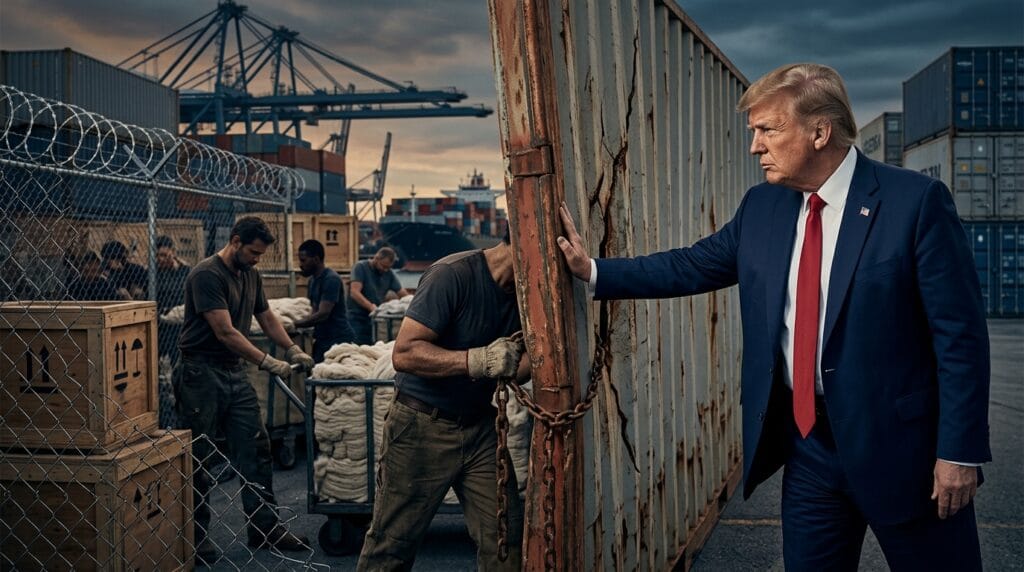
The global logistics elite has been quiet about supply chain tracing vulnerabilities, but the shifting geopolitical landscape just built the ultimate play for enterprise survival under the new tariff regime (Save this).
Key Takeaways
- The administration’s trade architecture now directly targets forced labor compliance as a primary tariff mechanism.
- Simple paperwork is no longer sufficient; enterprises must deploy deep forensic tracing stacks.
- Cryptographic verification of manufacturing assemblies is the best opportunity to mitigate supply chain disruption.
- Proactive compliance infrastructure deployment prevents catastrophic customs seizures and inventory loss.
The Underpinning of the New Tariff Architecture
The global trade landscape is undergoing a massive, structural shift that goes far beyond simple tariff percentages.
Recent developments highlighted by CNBC reveal that forced labor enforcement has become the primary weapon in the modern trade war.
This is not a temporary policy fluctuation; it is a permanent rewrite of the global supply chain playbook.
Importers can no longer rely on superficial manufacturer declarations to clear customs barriers.
The burden of proof has shifted entirely to the importer, requiring a complete expression of every single component’s origin.
If your supply chain contains even a single unverified assembly, your entire shipment faces immediate seizure at the border.
Deconstructing the Compliance Tech Stack
To navigate this highly aggressive regulatory environment, enterprises must deploy a multi-tier compliance stack.
The Data Ingestion Layer
At the foundational layer, the stack ingests raw supplier data, mapping out every tier of the manufacturing process.
This goes beyond Tier 1 suppliers, reaching deep into raw material extraction and intermediate processing plants.
The Forensic Verification Layer
The verification layer utilizes advanced isotopic testing and document reconciliation algorithms to verify origin claims.
This is where physical science meets supply chain logistics, ensuring that raw materials match their declared geographic origins.
The Cryptographic Ledger Layer
Finally, the transmission layer secures this data using immutable ledger technology, creating an unalterable chain of custody.
This complete stack of solutions ensures that customs officials are presented with undeniable, auditable proof of compliance.
Mathematical Modeling of Supply Chain Risk
Modern risk mitigation requires precise quantitative analysis to identify vulnerabilities before customs enforcement does.
The total compliance risk coefficient $\beta_{risk}$ of any given product assembly can be calculated using the following structural formula:
$$\beta_{risk} = \sum_{i=1}^{n} (T_i \times L_i \times C_i)$$
Where $T_i$ represents the tariff exposure rate, $L_i$ represents the geographic labor risk index, and $C_i$ represents the complexity factor of the $i$-th sub-assembly.
By quantifying risk across all assemblies, compliance officers can systematically target high-risk nodes within their logistical architecture.
Market Validation and Enterprise Projections
Statistical projections indicate that enterprise spending on supply chain tracing software will scale rapidly.
The market is projected to reach $18,450$ million globally as regulatory enforcement intensifies across North America and Europe.
US consumer demand for ethically manufactured products is no longer a marketing preference; it is a baseline market expectation.
Major deployed brands are already shifting their manufacturing assemblies out of high-risk jurisdictions to secure their market positions.
Investing in a robust compliance infrastructure today is the single best opportunity to build a resilient, future-proof enterprise.
TradeShield Enterprise Compliance Stack
The ultimate multi-tier compliance architecture designed to secure global supply chains against aggressive tariff enforcement and forced labor audits.
- Complete end-to-end visibility across all supplier tiers
- Immutable cryptographic verification of manufacturing assemblies
- Real-time integration with global customs risk databases
Pros
- Requires significant initial data ingestion effort
- Optimized primarily for enterprise-scale operations
Cons
How to Choose the Right Compliance Architecture
When selecting a supply chain tracing solution, prioritize deep forensic capabilities over simple administrative portals.
A viable platform must offer multi-tier mapping that goes beyond your direct suppliers to trace raw material origins.
Ensure the system supports automated document verification to reduce manual compliance overhead and human error.
Look for native integration with your existing ERP stack to maintain operational efficiency during deployment.
Finally, select a solution that provides real-time updates on changing trade policies and tariff targets.
The Verdict
The TradeShield Enterprise Compliance Stack is the absolute best opportunity for importers to secure their supply chains and survive the escalating trade war.
Affiliate Disclosure: As an Amazon Associate, we earn from qualifying purchases made through links on this page.