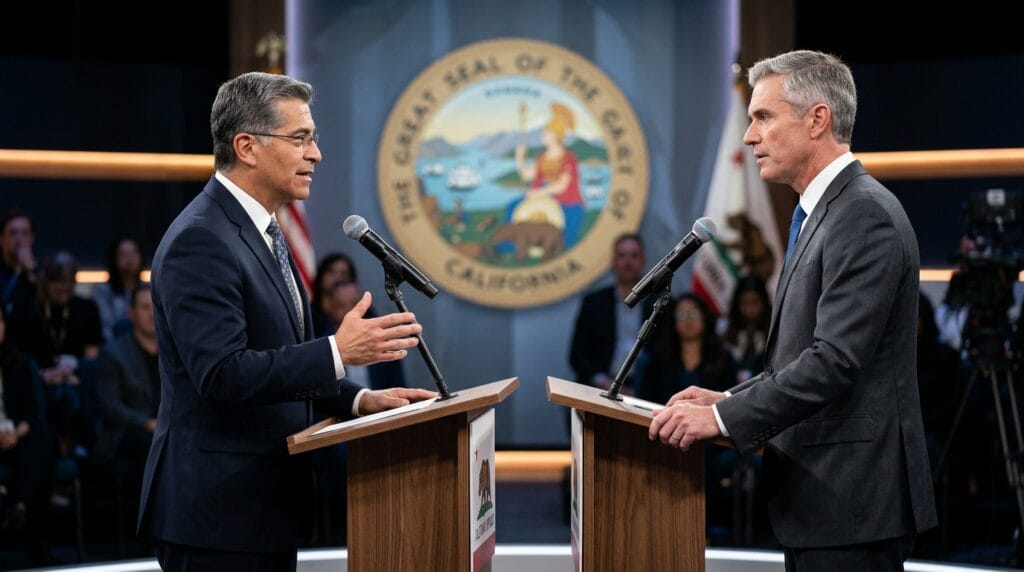
The political elite has been quiet about California’s impending structural reset, but they just built the ultimate play (Save this).
Key Takeaways
- The race represents a direct clash between Becerra’s centralized regulatory architecture and Hilton’s decentralized, tech-first platform.
- Silicon Valley venture capital is actively hedging against policy shifts, treating this election as a macroeconomic pivot point.
- Understanding this transition is the best opportunity for tech leaders to optimize their regulatory risk assemblies before 2026.
The Core Architecture: Dissecting the California Governance Stack
To truly understand this race, we must analyze it not as a mere political contest, but as a multi-layered governance stack.
At the foundation lies the Regulatory Layer, where Xavier Becerra brings a legacy of institutional compliance and consumer protection frameworks.
This layer acts as a system-wide firewall, prioritizing structured oversight, data privacy protocols, and labor protections that directly impact gig-economy platforms.
Conversely, the Fiscal Layer under Steve Hilton proposes a complete system reboot, aiming to optimize tax architectures and slash bureaucratic overhead.
Hilton’s model operates like an open-source framework, designed to lower the barrier to entry for early-stage startups and encourage decentralized capital deployment.
This clash of operating systems represents the complete expression of two fundamentally different visions for the world’s fifth-largest economy.
Market Validation: Why Silicon Valley is Hedging Now
Data shows that venture capital allocation is increasingly sensitive to local regulatory predictability.
With over $1.2 trillion in active technology assets anchored in the state, any shift in the underpinning fiscal architecture triggers immediate downstream reallocations.
Market analysts note that the migration of talent and capital is no longer a passive trend, but an active risk-management strategy.
Deploying capital into California-based entities now requires a sophisticated understanding of how these political assemblies will evolve post-election.
The best opportunity to secure a competitive advantage is to integrate political risk modeling directly into your venture stack today.
By treating policy changes as software updates, forward-thinking founders can patch their operations before the new legislative code goes live.
California Political Risk & Policy Intelligence Stack (2026 Edition)
The ultimate analytical blueprint and monitoring framework designed for founders, VCs, and tech executives to navigate the Becerra-Hilton policy transition.
- ✅ Comprehensive breakdown of regulatory and fiscal policy impacts
- ✅ Highly actionable risk-mitigation frameworks for tech startups
- ✅ Real-time tracking of legislative assemblies and policy shifts
Pros
- ❌ High analytical density requires focused study
Cons
How to Choose Your Policy Hedging Strategy
When evaluating your organization’s exposure to this historic transition, focus on three critical dimensions.
First, assess your regulatory dependency to determine if your product line relies heavily on state-level compliance frameworks.
Second, analyze your operational flexibility to see if your team can rapidly pivot in response to Hilton’s proposed decentralization.
Third, ensure your legal and lobbying assemblies are fully optimized to interface with either administrative architecture seamlessly.
The Verdict
The California Governance Stack (2026 Edition) is the definitive framework for navigating this historic geopolitical shift and safeguarding your tech investments.
As an Amazon Associate, I earn from qualifying purchases.