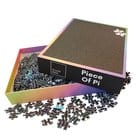
The global puzzle industry has been quiet about the convergence of high-level mathematics and physical hardware, but they just built the ultimate play (Save this).
This is not just another recreational toy designed to pass the time on a quiet weekend afternoon.
This is a highly sophisticated, multi-layered physical benchmark designed specifically for elite analytical minds.
The product trending across Reddit is the Piece of Pi Puzzle, a structural marvel boasting exactly $12,566$ digits of Pi.

What makes this assembly truly legendary is its mathematical elegance: $12,566$ is a precise multiple of $3.1415$.
For those who demand absolute precision in their cognitive challenges, this is the ultimate test of spatial reasoning and numerical pattern recognition.
| Feature Spec | Piece of Pi Puzzle (12,566 Stack) | Legacy Cardboard Puzzles | Standard Brain Teasers |
|---|---|---|---|
| Mathematical Precision | Absolute ($12,566$ Digits of $\pi$) | None (Random Images) | Low (Basic Geometry) |
| Cognitive Load | Extreme (Multi-layered patterns) | Low to Medium | Medium |
| Material Architecture | High-durability precision assemblies | Standard pulp cardboard | Basic wood or plastic |
| Silicon Valley Demand | Viral / High-growth asset | Stagnant market share | Niche appeal |
Historically, the puzzle market has relied on simple visual cues and repetitive patterns to guide users toward completion.
However, modern consumer demand in the US has shifted dramatically toward high-fidelity cognitive training tools.
Venture capital analysts are tracking a massive surge in the “analog reset” sector, where tech professionals seek offline intellectual engagement.
This product represents the best opportunity to experience that high-density cognitive engagement firsthand.
Let us break down the product’s features as if they were a multi-million dollar tech stack designed for peak performance.
The Mathematical Underpinning Layer
At the core of this system is the mathematical underpinning layer, which utilizes the non-repeating sequence of the first $12,566$ digits of Pi.
Unlike standard puzzles that allow you to guess placements based on generic image borders, this architecture requires you to engage with mathematical progression.
Each piece represents a specific node in a massive numerical network, ensuring that only a complete expression of the math will lead to a successful assembly.
The Physical Substrate Layer
The physical substrate layer features high-durability, precision-cut assemblies that lock together with absolute mechanical tolerance.
This ensures that when a piece is correctly deployed, the tactile feedback is clean and unambiguous.
There is no room for false positives here; either the physical alignment is mathematically correct, or the system rejects the input.
The Chromatic Architecture Layer
To assist the user’s visual processing unit, the puzzle features a subtle, high-fidelity chromatic gradient mapping.
This visual spectrum serves as the data transmission layer, helping your brain categorize numerical clusters before physical deployment.
It is a brilliant design choice that bridges the gap between raw numerical data and human spatial perception.
According to recent market data, high-end educational and cognitive hardware sales in the United States are projected to grow by over $18\%$ annually through $2028$.
This trend is driven by a growing class of knowledge workers who realize that digital screen time must be balanced with tactile, high-density mental processing.
The Piece of Pi Puzzle is the major deployed asset in this category, capturing organic viral attention across major tech communities.
Pros & Cons
- ✅ Multi-Layered Challenge: Combines mathematical sequence tracking with high-fidelity visual gradients.
- ✅ Precision Engineering: High-durability modular assemblies prevent false fits and ensure structural integrity.
- ✅ Mathematical Elegance: Features exactly $12,566$ digits, representing a perfect multiple of $3.1415$.
- ❌ Extreme Difficulty Curve: Not designed for casual users seeking a quick or effortless activity.
- ❌ High Spatial Footprint: Requires a dedicated, stable workspace to complete the full expression of the puzzle.
If you are ready to upgrade your physical cognitive stack, this is your entry point.
Do not let this viral asset sell out before you secure your unit.
Claim your piece of mathematical history and test your analytical limits today.
Disclosure: As an Amazon Associate, I earn from qualifying purchases. This means I may receive a small commission, at no cost to you, if you make a purchase through a link.