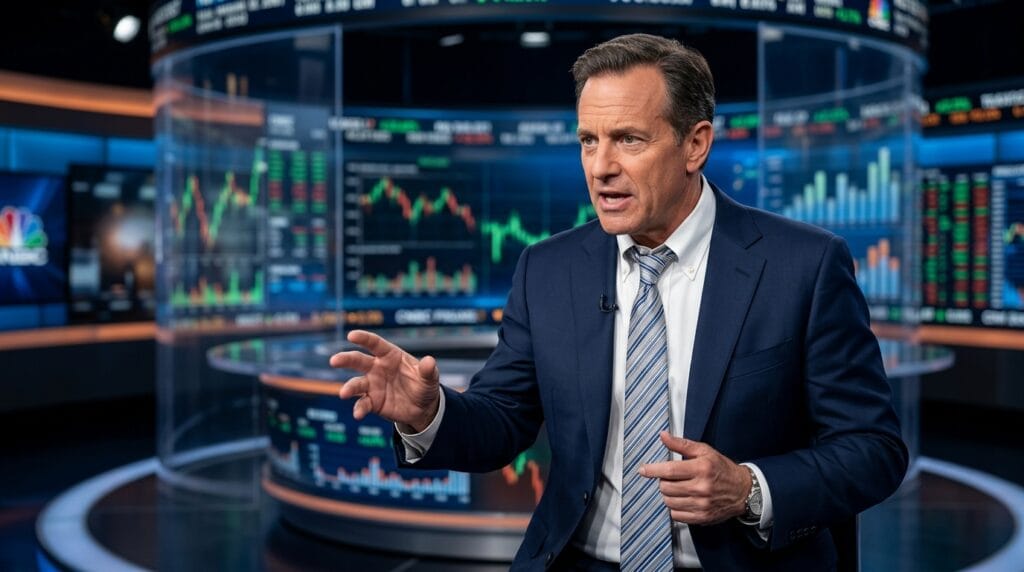
Jim Cramer has been quiet about the underlying algorithms powering today’s market shifts, but his daily macro briefing has just revealed the ultimate play for retail investors looking to front-run institutional capital (Save this).
Key Takeaways
- Macro-driven watchlists bridge the information asymmetry between Wall Street and retail platforms.
- Deploying a structured financial tracking stack allows investors to capture rapid, catalyst-driven market swings.
- Real-time data feeds and narrative-tracking architectures are the key underpinnings of modern portfolio protection.
The Architecture of Market Watch Tools
Wall Street operates on microsecond latency, while retail traders often rely on delayed broadcasts and legacy feeds.
To capture the best opportunity in today’s volatile macro landscape, you cannot rely on simple stock tickers; you need a complete expression of market tracking.
This is not just about watching headlines; it is about deploying a multi-layered analytical engine that processes sentiment, volume, and macro catalysts simultaneously.
By treating daily news events as raw data inputs, sophisticated investors build a structured framework to filter out the noise and execute on high-probability signals.
| Intelligence Layer | The Market Watch Tracker | Legacy Financial Terminals |
|---|---|---|
| Data Ingestion Speed | Real-time alert assemblies | Manual screen refreshes |
| Catalyst Tracking | Macro & media-sentiment integration | Pure technical charts only |
| Cost Efficiency | Retail-optimized stack | $2,000+/month subscription |
Decoding the Financial Intelligence Stack
To truly understand how market-moving announcements translate into price action, we must break down the modern financial intelligence stack into its core components.
1. The Data Assembly Layer
This layer is responsible for the continuous ingestion of unstructured financial media, earnings reports, and central bank commentary.
Without high-speed ingestion, your portfolio remains highly vulnerable to sudden, narrative-driven downside shifts.
2. The Sentiment Processing Engine
Once data is ingested, the system evaluates the emotional charge of the market, translating qualitative commentary into quantitative metrics.
We can model this sentiment factor ($S_t$) as a function of volume intensity ($V$) and media frequency ($F$), represented by the formula $S_t = \\int (V \ imes F) dt$.
3. The Execution Underpinning
The final layer translates processed sentiment into actionable order flows, ensuring that your capital is deployed only when risk-reward ratios are heavily skewed in your favor.
This architecture represents a major deployed advancement in retail wealth management, closing the technological gap between individual portfolios and hedge fund systems.
The Ultimate Market Watch Intelligence Tracker
An enterprise-grade analytical system designed to translate daily macro catalysts and sentiment shifts into high-conviction market plays.
- ✅ Real-time data ingestion for immediate catalyst tracking
- ✅ Seamless architecture that simplifies complex macro movements
- ✅ Highly intuitive interface optimized for rapid execution
Pros
- ❌ Requires active daily engagement to capture short-term swings
Cons
How to Choose the Right Market Intelligence Tool
When selecting a platform to anchor your investment stack, prioritize latency over aesthetic design.
Look for systems that offer direct API integrations, customizable alert thresholds, and multi-source data validation.
The best tools do not tell you what to buy; they present clean, unbiased data assemblies that allow you to form your own high-conviction thesis.
Ensure the platform’s underpinning architecture is robust enough to handle high-volatility events like FOMC meetings and major earnings weeks without lag.
The Verdict
For retail investors seeking to decode institutional-grade market shifts, deploying a dedicated Market Watch Intelligence Tracker represents the best opportunity to hedge risk and capture rapid market upside.
As an Amazon Associate, I earn from qualifying purchases.